


- door Daniel Pawlik
Shared Kids' Room Ideas – How to Create a Space Where Siblings Get Along Well
- door Daniel Pawlik
Do you remember those evenings when you built pillow forts with your siblings? Or when each of you fought for your space and hung a blanket as a border between "my" and "your" side? Sharing a room is not just a logistical challenge – it's the first lessons in compromise, respect, and... high-level diplomacy.
Today, as parents, you face a similar challenge. Only this time, you have to create a space that unites two different worlds – an older teenager with a penchant for vintage and a younger girl who dreams of a pink kingdom. Or two siblings of completely different ages with different needs and preferences.
Every room has its own story. I remember the room I shared with my sister – half aquamarine blue, half in various shades of purple. Looking back now, I see something beautiful in it. Those walls told the story of two girls learning to live side by side, sometimes harmoniously, sometimes in conflict, but always together.
Today, we can create something similarly valuable for our children. A sibling's room is not a battle for stylistic dominance – it's a space where two personalities learn to get along.
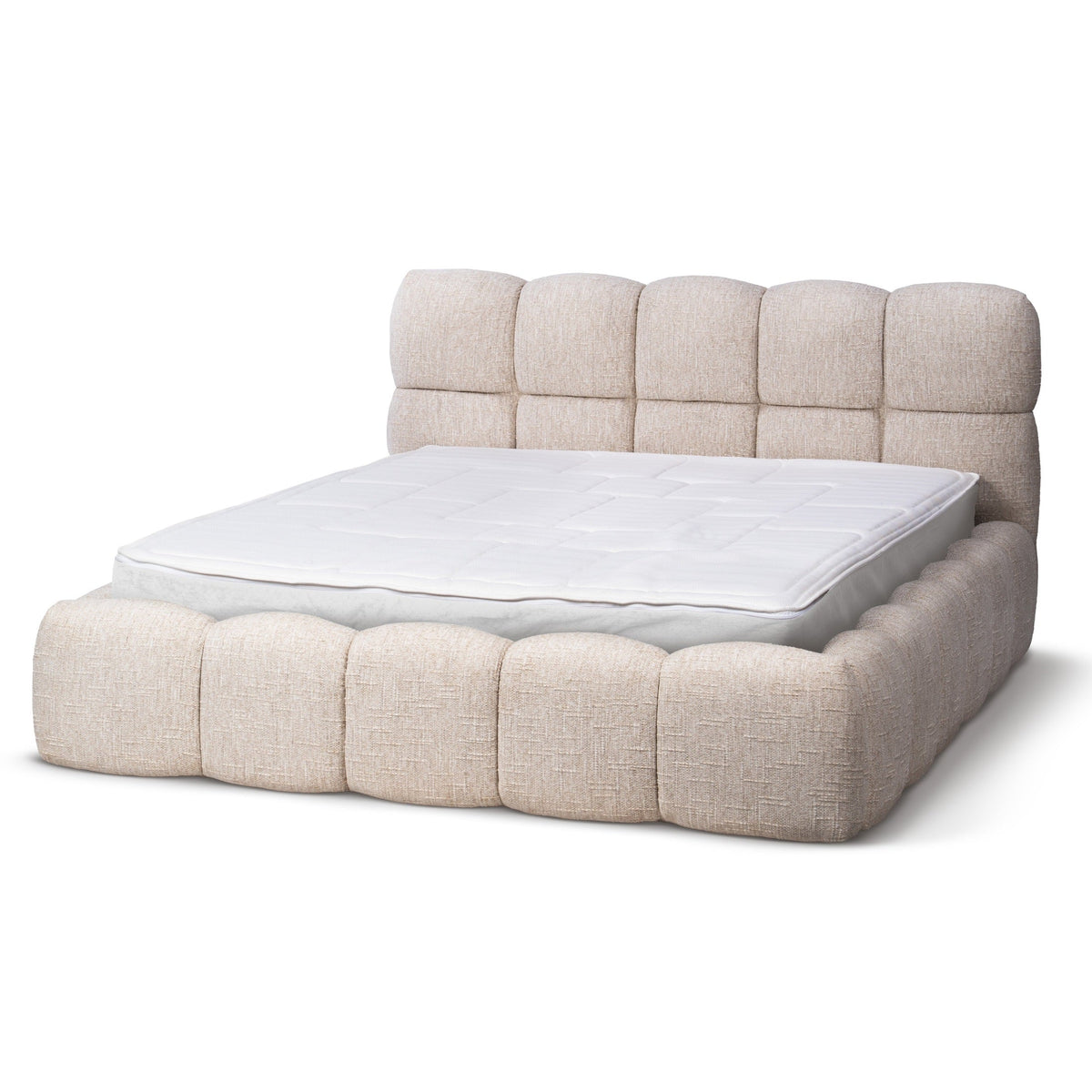
Let's start with the basics. The sleeping area is each child's very own retreat. Personalization is key here – each child needs their own little realm. An upholstered bed can make this possible. Choose the same models in different colors – this easily creates harmony while respecting your child's individuality.
For an older child, a bed in a subtle beige or dark green might be suitable, while a younger child might choose their favorite color pink or blue. And if space is limited, a bunk bed is not only practical – it's also an adventure that children will tell their friends about.
Here begins the real magic. Do you remember the band posters on the walls, the CD collections, the notebooks covered with stickers? Those were our first attempts to express ourselves. Today, we can give our children something much better.
Bean bags and chairs are the perfect solution – mobile, colorful, and individual. Each child can have their own bean bag in their favorite color and take it to their favorite spot. This is their kingdom, their little throne in the shared home.
Table or desk? Flexibility is crucial here. Upholstered benches can serve as additional seating at a shared table while also expressing individuality – each child has their own bench, their own color, and their own space.

Every child needs their own quiet space. A place where they can concentrate, reflect, and dream. This doesn't necessarily have to be a separate desk – sometimes a cozy corner with a comfortable chair and a small bookshelf is enough.
Older children might need a place to study, younger ones to play. But do these needs really exclude each other? A shared table can be used for homework in the morning and transformed into a building block castle in the afternoon. It's about using the space wisely – and teaching children to respect each other's needs.
Beige, delicate green, and natural wood tones – these colors are timeless. They form the foundation for a cozy children's room. Neutral walls and furniture offer every child the opportunity to personalize the space.
The younger ones might add pink pillows, the older ones posters of their favorite artists. And suddenly, harmony emerges in this diversity. Just like in life – we are different, yet we form a whole.
I know a family where the children restored their grandmother's old armchair themselves. The older child chose the fabric, the younger one painted the legs gold. The armchair now stands in their room as a symbol of joint work and compromise. It is these stories reflected in the furniture that strengthen the sibling bond.
Don't be afraid to give your children space to create. Mattresses with interchangeable covers, decorative pillows that can be rearranged again and again – these are all tools to create one's own space. 
I remember how my sister and I fought over every inch. "That's my half!" "You're not allowed in here!" Today, I see something beautiful in it – we learned diplomacy, compromise, and respect for each other's boundaries. These are lessons that have paid off in our adult lives.
A sibling's room is a laboratory of social life. It's a place where children learn that the world doesn't just revolve around them. That sometimes they have to give in, sometimes stand up for themselves, but always with respect for the other.
At Pillovely, we believe that every room tells a story. The story of a sibling's room tells of growing up, compromises, first conflicts, and the deepest bonds. It is a space that shapes relationships for years to come.
There is no one-size-fits-all solution for the perfect sibling room. Rather, your family history, your needs, and your children's personalities are crucial. We can merely offer you furniture that will last for years and endure children's drawings, bedtimes, and late-night conversations.
Because ultimately, it's not about perfectly coordinated colors or the latest trends. It's about creating a space where your children feel safe. Where they can be themselves, together and individually. Where they learn that diversity is an asset, not a problem.
You are someone. You are valuable. And so are your children.
Together, create a space that says a lot about them. A space that will still bring back nostalgic memories and a smile twenty years from now. Because a home is more than just furniture – it's about the feelings that reside within.
Pillovely – the love for cozy comfort. For all who want more.
Loveseat - What Is It, Who Is It For and How to Choose the Right One?
A loveseat is one of those pieces of furniture that can completely change how a room works. It is smaller than a classic sofa, more generous than a single armchair and often easier to place in compact interiors. A loveseat can create a cosy sitting area in a small living room, soften a bedroom corner, complete a reading nook or work as an additional seat next to a larger sofa. Its strength lies in proportion: it gives you the feeling of a sofa without taking over the whole room.
Lees meerover Loveseat - What Is It, Who Is It For and How to Choose the Right One?
EU vs UK Bed Sizes – Will UK Bedding Fit a European Bed?
European beds are 200 cm long, UK beds 191 or 198 cm. A simple EU vs UK bed size table in cm – and what it means for your mattress and fitted sheets.
Lees meerover EU vs UK Bed Sizes – Will UK Bedding Fit a European Bed?
Autumn colors at home – shades that bring peace and warmth
Do you remember autumn from your childhood, when the leaves changed color like a kaleidoscope, and your mom would pull out the pumpkin-colored sweater she'd worn since college? Or those evenings in front of the TV while a storm raged outside, and the lamplight in the house gave everything a warm, amber hue? Those were the days when no one talked about "color palettes" or "color stories"—colors simply existed, as natural as breathing. Today, when we can choose from 50 shades of gray (and no, I'm not talking about THAT book), we sometimes lose track of what truly makes a home feel cozy. At Pillovely, we believe that autumn colors aren't a trend—they're a return to what makes us feel safe. Because "You are someone"—someone who deserves a space filled with colors that snuggle like a grandma's blanket.
Lees meerover Autumn colors at home – shades that bring peace and warmth





Delen:
Transitional Style – the bridge between classic and modern
Old Christmas Baubles – Restoring Grandma's Christmas Ornaments